
The 4th Annual Scope 3 Summit brought together Chief Sustainability Officers, procurement leaders, finance teams and data specialists from organisations including Sanofi, AstraZeneca, Logitech, Zalando, Brenntag SE, Siemens Healthineers, Holcim, Evonik, Rabobank, Strabag and Jones Engineering to examine how European companies are turning Scope 3 ambition into measurable results. With CSRD assurance underway and both the GHG Protocol and SBTi standards in active revision, the discussion has shifted. The question is no longer whether to act on decarbonisation. It is how to execute, at scale, with credibility. Here are the key takeaways shaping how companies move from ambition to implementation.
1. Mandates Do Not Work. Collaboration Does.
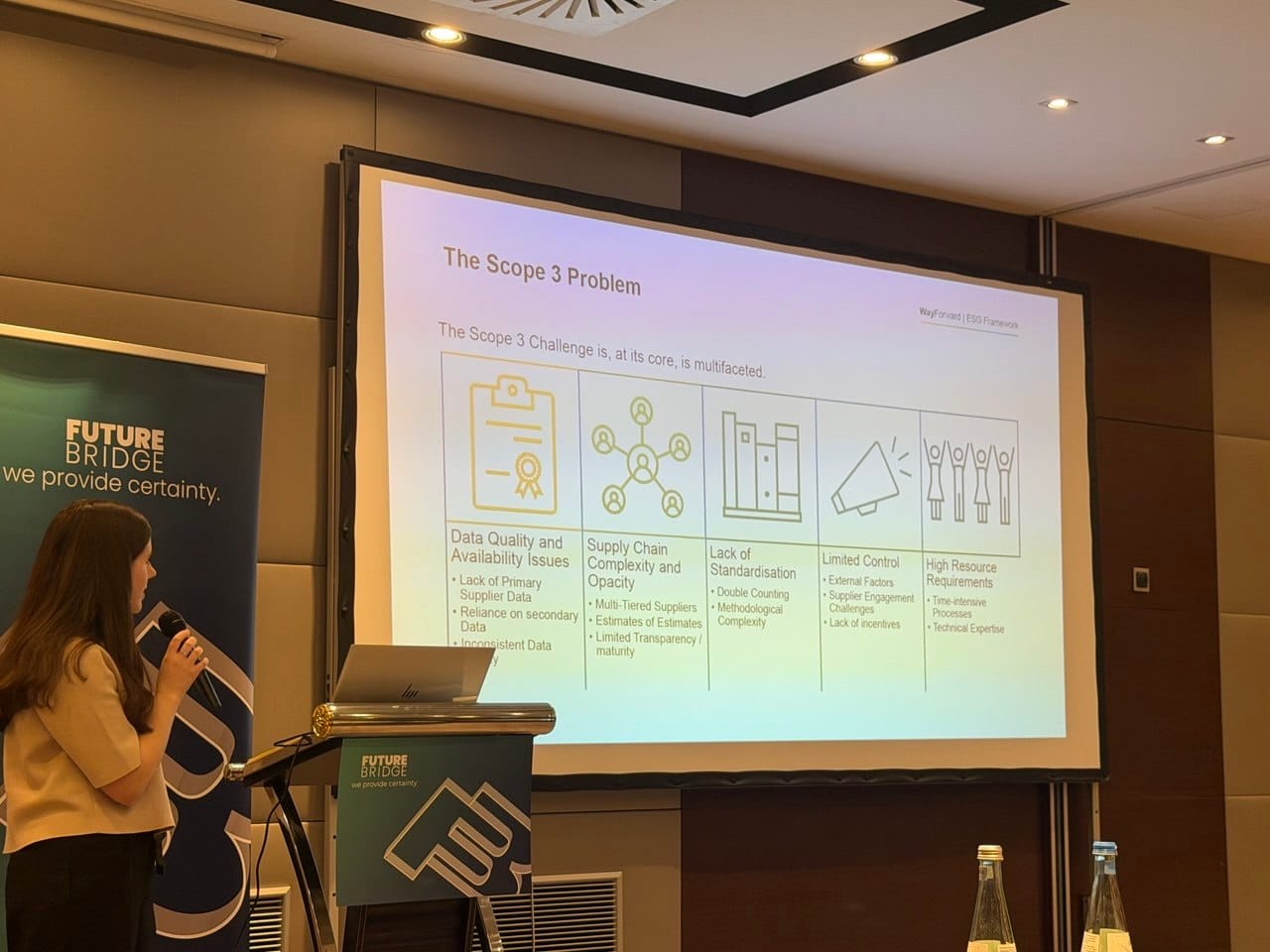
Giannis Kourousias, Global Head of Environmental Responsibility at Sanofi, opened with a figure that anchors the problem: 90% of the company’s approximately 3.7 million tonnes of CO2e sits in Scope 3, with purchased goods and services accounting for 64% of total emissions. Capital goods, upstream transport and business travel make up most of the remainder. At this scale, there is no meaningful Scope 3 decarbonisation without the active participation of suppliers. Kourousias was unambiguous: mandates do not work. Collaboration is the only viable model.
The practical output was Sanofi’s Active Pharmaceutical Ingredient decarbonisation programme. The team screened 400 suppliers, selected 10 strategic partners and brought them together for focused technical workshops. Sanofi shared its own emission data first, mapping hotspots at molecule level before asking anything in return. The outcome was molecule-level agreements targeting a 30% reduction across one of Sanofi’s largest Scope 3 categories.
Suppliers across geographies, including regions where engagement was not expected, proved willing to commit to ambitious decarbonisation targets. The limiting factor was not willingness. It was capability. Larger companies have more resources, experience and analytical infrastructure. That creates an obligation, not just an opportunity. If your supply chain cannot move at the required pace, your targets are not deliverable without active investment in enabling your partners.
Anja Rinn, Global Sustainable Procurement Manager at Holcim, reinforced the structural requirements on the buyer side. Embedding ESG into procurement means building it into category strategy, supplier screening, negotiation frameworks and supplier management. Not as an overlay, but as a core part of how sourcing decisions are made. Holcim’s approach focuses on equipping procurement teams with tools to weigh carbon alongside cost and quality, creating clear escalation pathways where trade-offs arise, and aligning cross-functional roadmaps to maintain accountability.
The takeaway is clear. High-impact Scope 3 decarbonisation depends on supplier collaboration, structured procurement and integrating carbon into every sourcing decision, forming the foundation for credible net zero pathway design and long-term carbon credit procurement strategies.
2. Design Is a Scope 3 Strategy, Not Just a Product Consideration.
Caroline Kennedy, Director of Climate, Circularity and Reporting at Logitech, made one of the summit’s most commercially relevant points. For product companies, Scope 3 decarbonisation is fundamentally a design problem, not an operational one.
Logitech ships millions of units across hundreds of thousands of SKUs. A single design decision, one material swap or small reduction in a high-emission input, scales quickly. The design phase determines around 80% of a product’s environmental impact. By the time a product reaches manufacturing, most Scope 3 emissions are already locked in. The implication is clear. Focusing on procurement or logistics alone targets the wrong part of the problem.
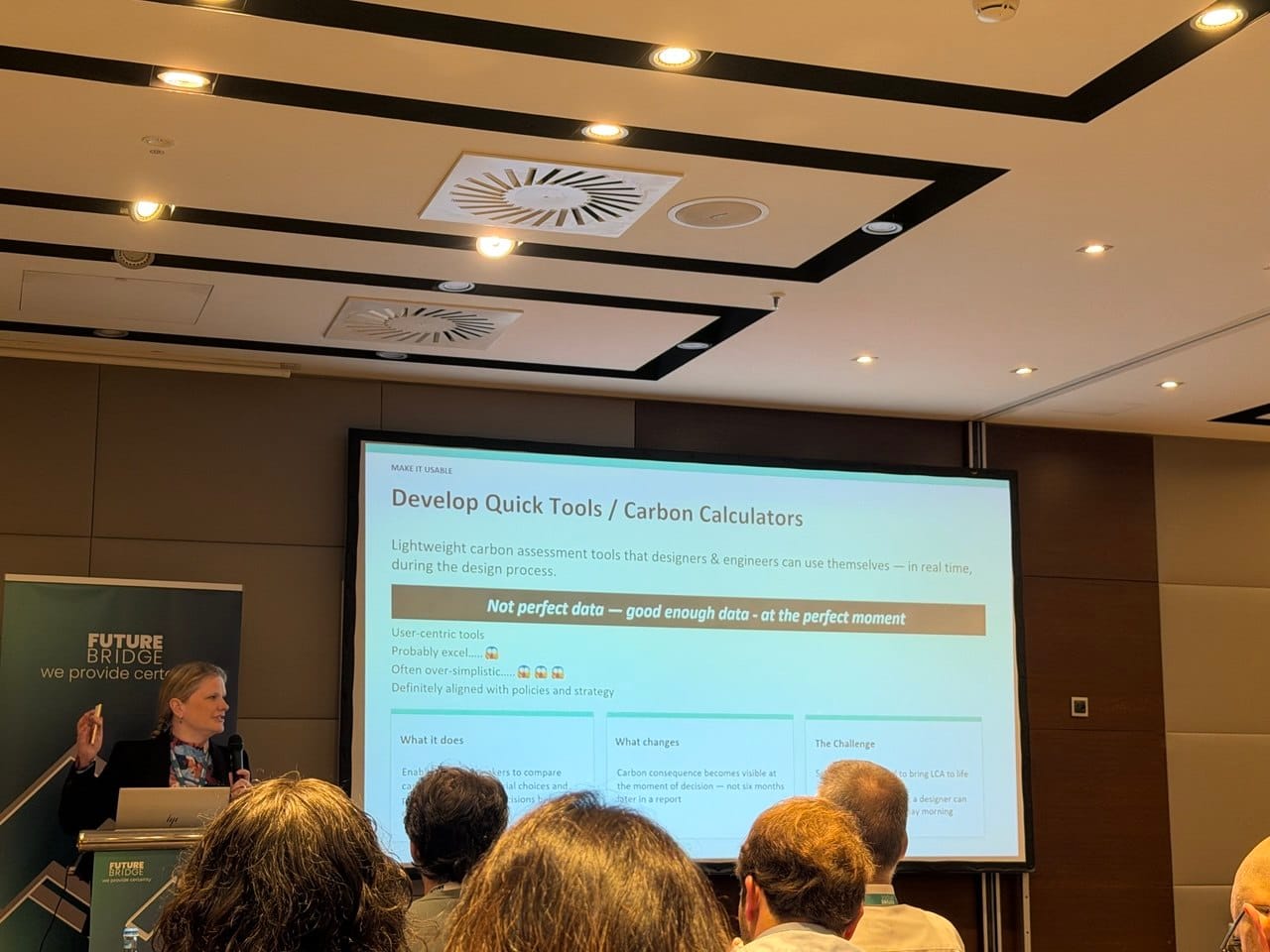
Logitech’s response centred on practical shifts. The team developed lightweight carbon assessment tools, lightweight carbon calculators that designers use directly during the design process, bringing directionally reliable data into decisions before key choices are fixed. They also embedded sustainability champions across product teams, shifting accountability for sustainable design into the business itself. By later product generations, upfront cost premiums had normalised as processes adapted and supplier relationships matured.
AstraZeneca’s James Cunningham extended this design-led approach into the pharmaceutical context. With a 90% Scope 3 reduction target by 2045, and use of sold products, specifically inhalers, alongside purchased goods and services as the dominant emission sources, AstraZeneca has built a structured LCA programme spanning API production, formulation, packaging, distribution, patient use and end of life. The key insight is consistent. Data does not need to be perfect to drive action. Directionally reliable data is sufficient for prioritisation and early decision-making. The LCA programme itself is not the deliverable. The value lies in understanding where emissions sit, what drives them and where intervention is feasible. AstraZeneca has also developed internal tools that allow scientists and product teams to model lower-carbon options during development, before regulatory approval locks in high-cost, high-emission pathways.
3. The Execution Gap Is a Data Distribution Problem, Not a Data Availability Problem.
Wolfgang Edel from Brenntag SE described a position many large organisations will recognise. The company manages over 10,000 suppliers, 20,000 products and 160,000 customers, with a Scope 3 footprint exceeding 30 million tonnes. Brenntag has carbon data covering over 80% of its volume. The issue is not availability but distribution: buyers still optimise on price and performance, while carbon data sits in a separate function. Until it is embedded into procurement and daily decision-making, Scope 3 will remain a reporting exercise rather than a driver of emissions reduction.
Frameworks need to move from reporting to execution. The requirement is not more granular accounting, but a mechanism that makes carbon performance visible and actionable at the point of decision. Without that shift, better data will continue to produce better reports, not better outcomes.
Victoria McCormac from Jones Engineering illustrated this at a smaller scale. Jones Engineering, a 4,500-person engineering contractor operating across 19 countries, has 96% of emissions in Scope 3, largely from purchased goods and services. The company began its responsible business programme in 2019 and received SBTi approval in 2023, targeting a 50.4% reduction across Scope 1, 2 and 3 by 2032.
The constraint is structural. In most projects, specifications are set before Jones Engineering is involved. The company installs HVAC, sprinkler systems and mechanical infrastructure into an already defined build, limiting its ability to influence material selection. This reinforces a broader point. Scope 3 reduction depends on upstream collaboration across the value chain, often beyond direct control.
The company selected SWEEP as its carbon management platform following a structured evaluation, prioritising usability, integration and scalability. The programme has since delivered 14 supplier workshops involving 103 suppliers, focusing on active engagement rather than passive data collection. The lessons are consistent. Prioritise high-impact areas, focus on primary audit-ready data over industry averages, and integrate carbon into procurement and finance workflows rather than running parallel processes.
4. Carbon Credits Require a Portfolio Strategy, Not a Procurement Transaction.
Dr Jochen Gassner, Chief Commercial Officer at Removall Carbon, outlined how corporate carbon credit use is evolving. Demand is forecast to grow from 175 million tonnes in 2025 to 275 million tonnes in 2030 and 700 million tonnes in 2035. Removals already account for 25% of the market and are expected to continue increasing as corporates shift from avoidance to removal. High integrity carbon removal credits, aligned with ICVCM and SBTi frameworks, are becoming the baseline for credible net zero strategies. Prices are expected to rise as demand accelerates and supply tightens.
The governance landscape is tightening in parallel. Article 6, EU CRCF, CORSIA, CBAM and SBTi updates are converging voluntary and compliance markets. For corporate buyers, this is not theoretical. It directly affects carbon credit procurement today, as only a subset of credits will remain credible under future regulatory and investor scrutiny.
Gassner’s framework centres on two tracks. First, abatement through net zero pathway design, baseline setting, target definition and transition planning. Second, managing residual emissions through structured carbon credit procurement. This includes forecasting the carbon curve, defining quality criteria, and building a carbon removal portfolio across spot, mid-term and long-term offtake agreements, with a gradual transition toward permanent removals.
The shift from spot purchasing to forward and offtake agreements is significant. These introduce delivery risk, making project maturity, developer track record and contract structure critical due diligence factors. Carbon credit procurement is therefore becoming a financial discipline, requiring structured evaluation and ongoing monitoring.
Nature-based removals dominate near-term supply and are currently the most scalable. Engineered removals, including enhanced rock weathering, BECCS and direct air capture, remain earlier stage but are expected to play a growing role. Prices currently range from 200 to 800 EUR per tonne. A credible long-term carbon removal portfolio combines both, with the balance shifting toward permanent solutions as the market matures.
Verra’s Luca Carbonara introduced the S3S Programme, a new certification standard designed to bridge carbon credits and Scope 3 inventory claims. The programme issues Scope 3 Units through standardised MRV methodologies, covering areas such as agricultural land management, CO2 use in concrete and industrial heat electrification. Unlike traditional credits, these are designed to link directly to value chain interventions, enabling more credible Scope 3 claims. Version 1.0 is expected by the end of 2026 and is likely to influence how companies integrate carbon markets into their Scope 3 strategies.
5. Financial Institutions Are Using Macro-Economic Models to Estimate What Their Clients Cannot Yet Report.
Rabobank’s Dr Barbara Kolbl outlined an approach to financed Scope 3 emissions that has wider relevance. Where reported data is unavailable, Rabobank combines sector emissions data with environmentally extended input-output models to estimate upstream and downstream emissions across its private sector loan portfolio. These models rely on sector averages and carry a time lag, but they are already in use.
6. Standards Are Evolving and Timelines Matter More Than Perfection.
SBTi and GHG Protocol updates point toward more action-oriented targets, greater flexibility for complex value chains and stricter data quality transparency. Panellists scored their data five to six out of ten for execution. The message: do not wait for perfect data. Many decisions can be made now.
The concern from the room was timing and complexity. Companies need clarity for second-generation 2040 and 2050 targets. Frameworks that are technically rigorous but operationally unworkable will not deliver emissions reduction.
What This Means for Carbon Markets
Demand for high integrity carbon removal credits is increasing, and the composition of that demand is shifting. Buyers are moving from avoidance-led spot purchases toward removal-focused, long-term offtake agreements aligned to their residual emissions trajectory. At the same time, integrity standards across voluntary and compliance markets are converging, narrowing the pool of credits that will remain credible under regulatory and investor scrutiny over the next five to ten years.
The gap between commitment and execution remains the core barrier to corporate decarbonisation. Most organisations now have science-aligned targets. Far fewer have a carbon credit procurement strategy that holds over a ten-year horizon, a supplier engagement programme delivering measurable reductions at product or material level, or a data architecture that embeds carbon into commercial decision-making across procurement and product teams.
This is where structured approaches and platforms like Carbonaires and Roadmapr support faster, more credible decisions. Net zero pathway design and carbon credit procurement are not separate activities. They form a single system, linking residual emissions, supplier strategy and a long-term carbon removal portfolio. Organisations that build this as an integrated architecture from the outset will be better positioned than those that approach it sequentially.
Carbonaires Perspective
At Carbonaires, we see three clear shifts from the conversations in Berlin.
First, the supplier engagement model is maturing. The companies making real progress are not sending questionnaires. They are investing in supplier capability, sharing their own data first, and co-developing roadmaps at product and material level. Decarbonisation is treated as a shared commercial objective, not a compliance exercise. This requires significant internal preparation before external engagement begins.
Second, carbon credit procurement is becoming a financial discipline. Forward and offtake agreements introduce delivery risk, requiring structured due diligence, robust contract terms and ongoing project monitoring. The shift from transaction to carbon credit portfolio strategy is critical. Organisations buying credits without a long-term plan aligned to their emissions trajectory are building exposure, not security.
Third, data quality thresholds for credible climate claims are rising faster than most organisations can adapt. The companies moving forward are not waiting for perfect data. They are acting on directional data and improving over time. This is the most commercially rational approach given how standards, market expectations and investor scrutiny are evolving.
Companies that build execution infrastructure now, through supplier programmes, structured carbon credit procurement and long-term carbon removal portfolios, will hold the advantage as regulation tightens. The gap between credible and non-credible climate strategies is becoming a clear commercial differentiator.
Event Details
Final Thought
Carbon markets and Scope 3 strategy are now converged. Carbon credit procurement is a core part of net zero pathway design, not a compliance exercise. Companies building structured carbon removal portfolios and integrating procurement into emissions strategy are already gaining a commercial advantage.
The gap between ambition and execution is an infrastructure problem. Closing it will define corporate decarbonisation over the next five years.