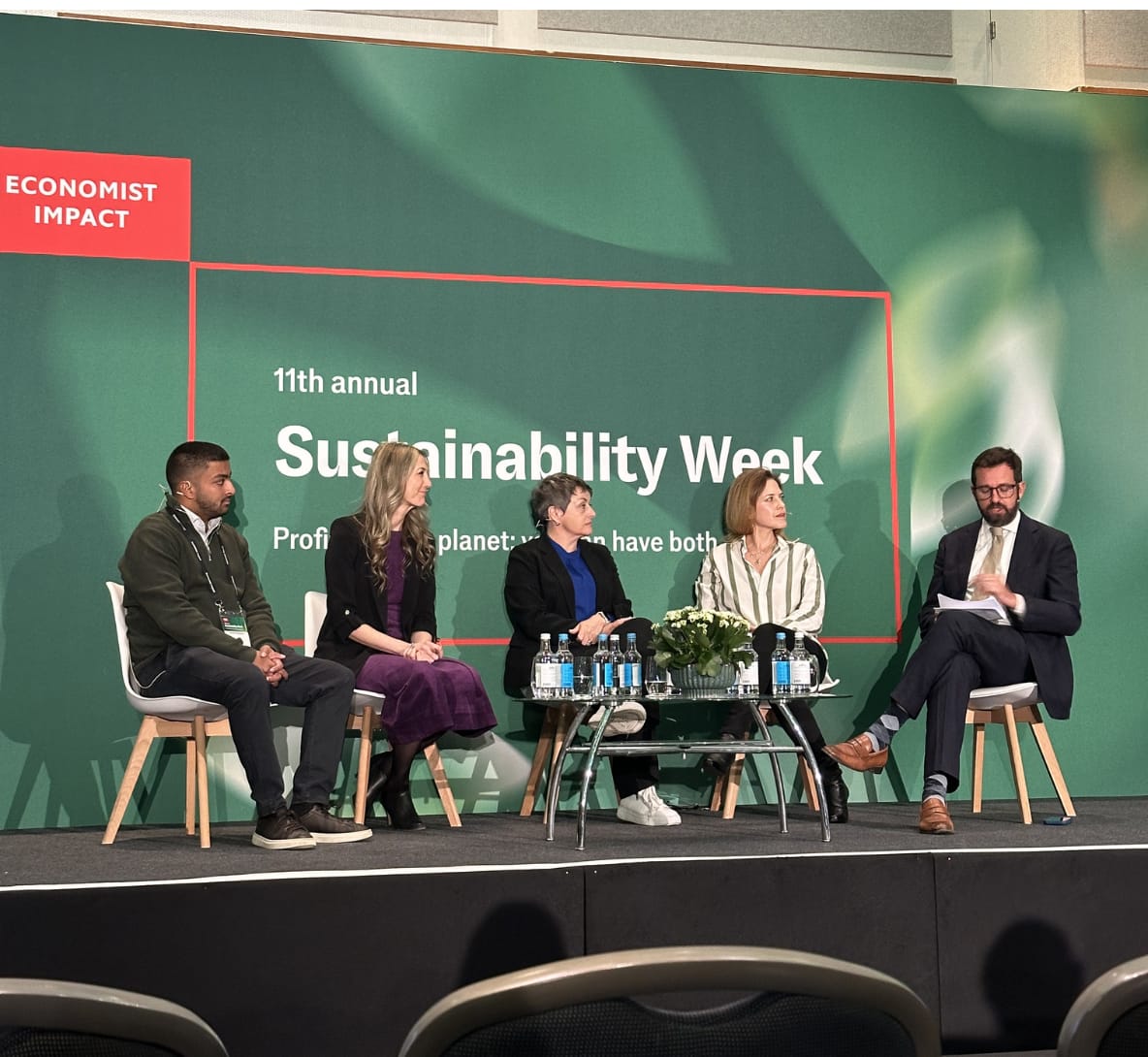
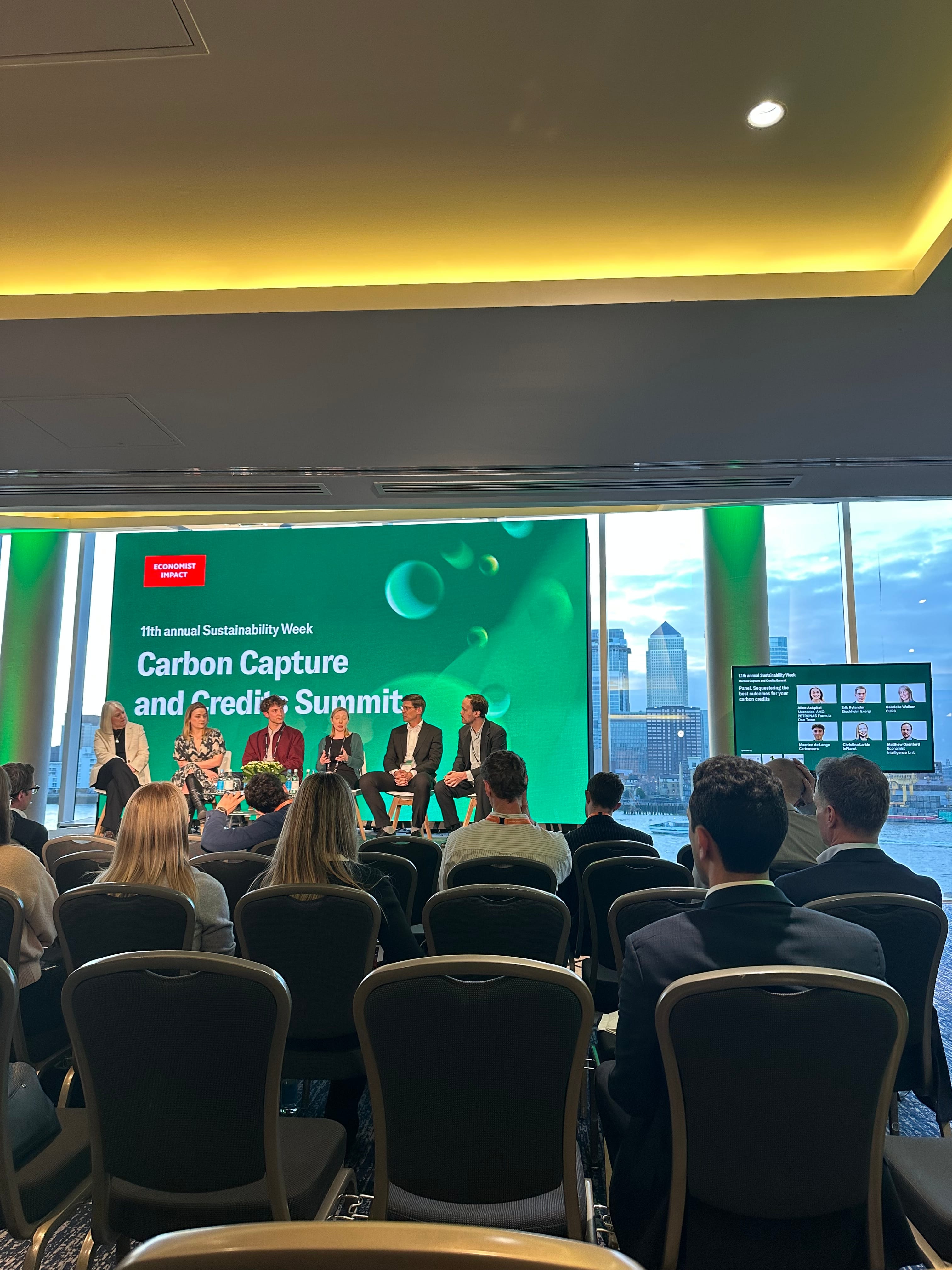
The Economist Impact 11th Annual Sustainability Week brought together more than 2,500 senior sustainability leaders, CFOs, investors, and innovators at the InterContinental London. Across two days of panels, case studies, and conversations, a set of clear and consequential themes emerged — themes that directly shape how Carbonaires thinks about the carbon removal market, corporate demand for high-quality credits, and the role of structured finance in accelerating decarbonisation. This is our read of what matters most — and what it means for companies navigating their path to net zero.
1. ‘Climate’ is out. ‘Resilience’ is in.
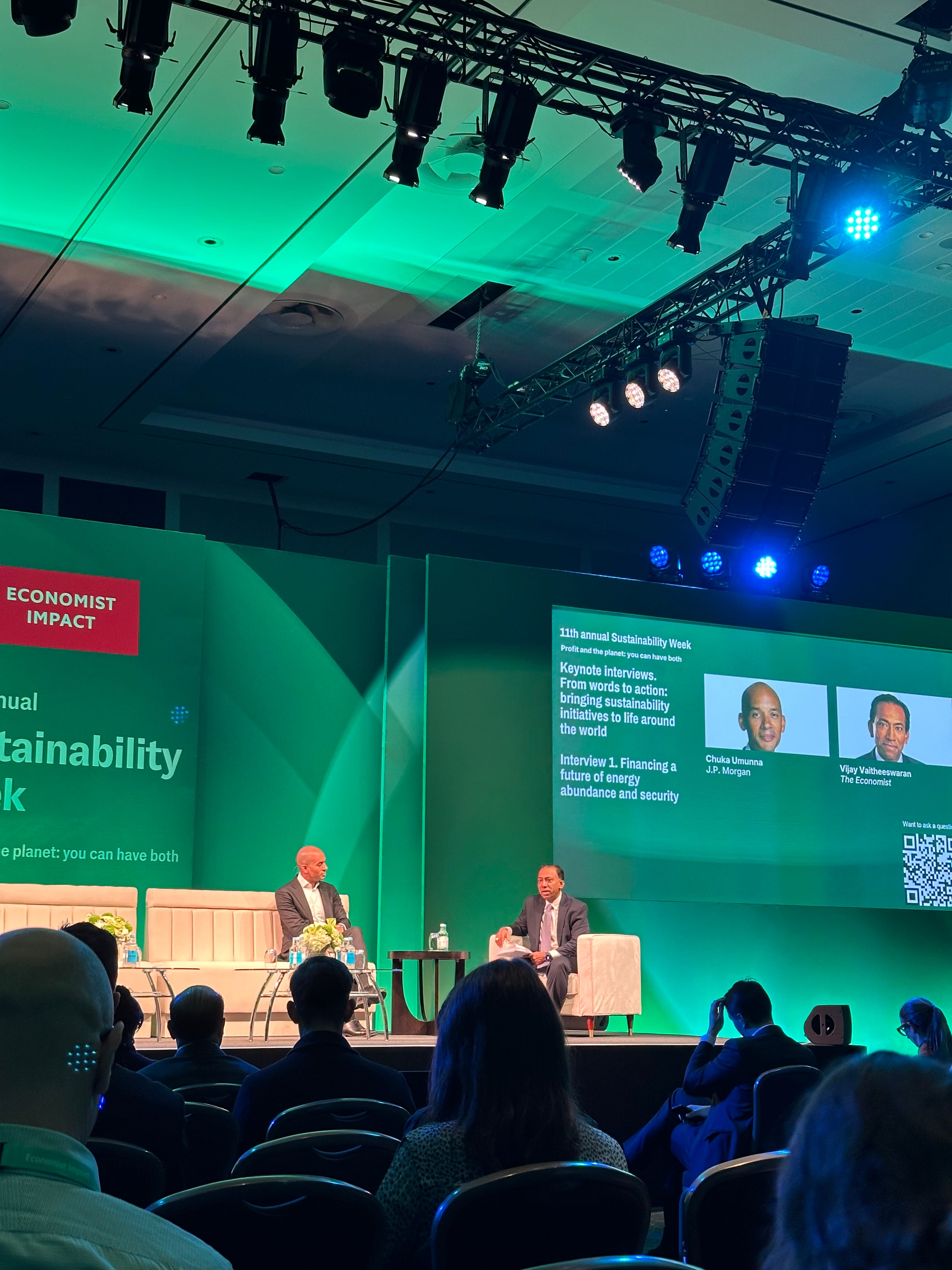
One of the most striking linguistic shifts at this year’s conference was the quiet retirement of ‘climate tech’ as a category — replaced, in board conversations and financing frameworks alike, by the language of resilience, security, and continuity.
Major financial institutions at the event signalled trillion-dollar commitments framed not around climate ambition, but around long-term business security. The implication is significant: sustainability decisions are increasingly being driven not by values-led commitments, but by hard financial risk calculations.
When companies calculate what inaction actually costs — lost customers, damaged infrastructure, supply chain failure — the economics of decarbonisation become undeniable.
This reframing is good news for the carbon removal market. Removal credits, particularly those tied to durable, verifiable outcomes, increasingly fit within a ‘resilience’ narrative. They represent a genuine, quantifiable contribution to a company’s long-term climate exposure. For Carbonaires, this underlines the importance of helping clients build the business case for carbon removal in the language of their CFO, not just their CSO.
2. The CFO is now the sustainability decision-maker
A recurring theme across multiple panels was the evolution of the CSO–CFO relationship, and who is increasingly holding the pen on sustainability strategy. The verdict was clear: sustainability has moved into the CFO function, and those who can’t navigate that shift will struggle to get things done.
Several powerful examples illustrated this. Currys’ sustainability journey began not with an ESG committee, but with the CFO walking in and saying they needed to do more. Virgin Media O2 calculated the precise financial cost of climate risk to their own infrastructure, the revenue lost when weather events take networks offline, and that calculation became the turning point for board engagement. While Vodafone embedded sustainability directly into growth strategy, not as a separate workstream.
The organisations making the most progress are those where sustainability and finance speak the same language and trust each other enough to act on it.
For Carbonaires, when we support companies on their decarbonisation journeys, we show up with CFO-grade rigour. That means clear financial modelling of carbon exposure, credible long-term offtake structures, and evidence-based due diligence that can withstand scrutiny from finance teams, not just sustainability leads.
3. Carbon credits are maturing — but the bar is rising
The carbon markets session at this year’s conference, framed as ‘Carbon Markets 2.0: Integrity, Innovation and Impact’, reflected a market that is genuinely growing up. The buyers in the room were more sophisticated. The questions were harder. And the tolerance for weak due diligence has narrowed significantly.
A standout case study involved Mercedes Petronas Formula 1 committing to purchase carbon removals as part of a net zero strategy by 2030, launching projects across multiple geographies and technology types. What made the deal instructive was the detail of how the internal pitch was structured: it framed carbon removals as part of a holistic sustainability story, spoke directly to the language and concerns of the CFO, emphasised innovation alignment, and foregrounded co-benefits alongside the core carbon case. The due diligence process was described as almost a joint development exercise — close, technical, and sustained.
Contrast this with one major corporate present at the conference, publicly committed to SBTi, who made clear their view that carbon credits are a band aid — at least for their own use. They may, however, consider credits for smaller suppliers in their value chain who lack the resources to decarbonise independently. This nuance is important: the market for high-quality carbon removal is segmenting, with sophisticated buyers demanding much more, and the door remaining open in supply chain contexts where credits can unlock decarbonisation that would otherwise be unachievable.
The buyers asking the hardest questions are often the best long-term partners. Rigour in due diligence is a signal of seriousness, not a barrier to entry.
Three questions were consistently surfacing from CFOs evaluating carbon removal purchases: Is this compliance-driven or voluntary? Is it materially relevant to our business? And, critically, is anyone else credible doing this? The third question is where market leadership matters. Early movers set the benchmark that others follow.
This is precisely the market context that Carbonaires is built for. Our role, facilitating offtakes, spot purchases, and investments into high-quality carbon removal projects, requires exactly the bank-grade rigour and deep technical understanding that sophisticated buyers are demanding. The gap between educated and uneducated buyers remains large, and bridging that gap with trusted expertise is where we add the most value.
4. Blended finance: The opportunity and the bottleneck
The transition finance sessions at Sustainability Week surfaced a frustration that will be familiar to anyone working in climate capital markets: the structures exist, the appetite exists, the projects exist — but deals are still not getting done at the speed the climate requires.
The diagnosis from the room pointed to a missing layer: connective tissue between project pipelines and the capital that could fund them. The Rothschild’s perspective was clear — blended finance doesn’t have to be complicated in theory, but in practice it is consistently blocked by structural complexity. LSE pointed to the lack of a clear demand signal as the root cause of inertia as well as noting that even where finance frameworks exist, the return timelines are often misaligned with the realities of long-duration climate projects.
Critically, several participants flagged that the ‘middle person’ role — the entity that can structure a project pipeline, speak credibly to both sides, and bring everything together — is chronically undersupplied. This is not a niche observation. It points to one of the most important capability gaps in climate finance today.
The project pipeline exists. The capital exists. What’s missing is the trusted intermediary that can hold both together and make the deal work.
There was also a notable geographic dimension. Venture debt and blended structures are entering deals earlier in the US, sometimes at Series A, while in Europe, this tends to happen later, at Series B and beyond. For project developers and investors operating across geographies, this asymmetry matters.
For Carbonaires, blended finance is increasingly central to how high-quality carbon removal projects get built. Offtake agreements that are structured to be bankable and the ability to bring structured financing alongside offtake commitments are all tools in this space. We see significant opportunity in being that connective layer — particularly for projects in geographies and technology types where institutional capital is still building confidence.
5. AI is changing the climate problem in both directions
The AI and sustainability sessions at this year’s conference captured the genuine complexity of artificial intelligence as a climate force. On one hand, AI is generating significant new energy demand through the rapid proliferation of data centres. On the other, it is beginning to unlock material efficiency gains in sectors from agriculture to manufacturing to emissions monitoring.
Several specific applications stood out: AI-powered climate modelling is improving the accuracy and resolution of weather prediction in ways that have direct implications for physical risk assessment. AI tools are being used to detect and manage methane leakage — one of the most potent near-term climate interventions available. In agriculture, AI is supporting the shift toward regenerative practices at scale. And in manufacturing, AI-driven optimisation is reducing energy intensity across industrial processes.
On the supply side of AI infrastructure, there were signals of genuine innovation in hardware efficiency including server systems designed to operate at higher temperatures, significantly reducing water use in cooling. Data centres are also increasingly locating near clean energy sources, enabled in part by user tolerance for slightly longer response times from large language models.
For the carbon removal sector, AI’s dual role matters. Growing data centre demand may accelerate corporate appetite for high-quality carbon removal as part of a broader net zero story — particularly among technology companies already investing in frontier climate solutions. At the same time, AI-driven monitoring and verification tools are beginning to reduce the cost and increase the credibility of MRV across carbon project types. Both trends strengthen the long-term market for the kind of projects Carbonaires supports.
6. Authenticity is the new minimum standard in sustainability communications
The marketing and communications sessions at Sustainability Week delivered a verdict that the industry has been moving toward for some time: sustainability claims built on veneer are failing, and the organisations cutting through are those where commitment is structural rather than superficial.
The strongest examples shared at the conference were those where sustainability had been woven into the product or business model itself — not applied as a layer of messaging on top. Sports organisations, consumer brands, and major corporates all pointed to the same principle: the moment a sustainability claim feels retrofitted, audiences disengage.
A related point was made about scope and scale. For many large organisations, Scope 1 and 2 emissions represent a tiny fraction of their total footprint — sometimes under one percent. The real challenge lies in Scope 3: fan travel, supply chains, capital expenditure, and product use. Addressing this credibly, with transparency about where the journey is and where it still needs to go, matters more than polished claims about progress already made.
The organisations earning trust on sustainability are those willing to be honest about how hard the problem is — and specific about what they are actually doing about it.
For Carbonaires and our clients, this reinforces the importance of grounding carbon removal within a genuine, credible decarbonisation story. Credits work best, commercially and reputationally, when they are part of a holistic narrative that includes real emissions reductions, not as a substitute for them. This is the kind of positioning we help companies build.
Carbonaires takeaway
Sustainability Week 2026 confirmed what we are seeing in the market: corporate demand for high-quality carbon removal is maturing, the financial structures to support it are becoming more sophisticated, and the buyers who remain in the market are the ones asking the most rigorous questions.
The shift from ‘climate’ to ‘resilience’ as the dominant frame is not a retreat from ambition. It is the integration of climate risk into the core financial logic of large organisations — and that integration is what makes the market durable.
For Carbonaires, the event reinforced the value of what we do: connecting companies with high-quality carbon removal projects through structures that are credible, transparent, and built to last. Whether through long-term offtake agreements, spot purchases, or investment into project development, we are focused on making the carbon removal market work — not just for early adopters, but for the mainstream buyers who are now starting to ask the right questions.
If you would like to discuss any of the themes in this post, or explore what a structured approach to carbon removal looks like for your organisation, we would be glad to connect.