ICVCM Core Carbon Principles
Core Carbon Principles - "A Global Threshold for Quality"
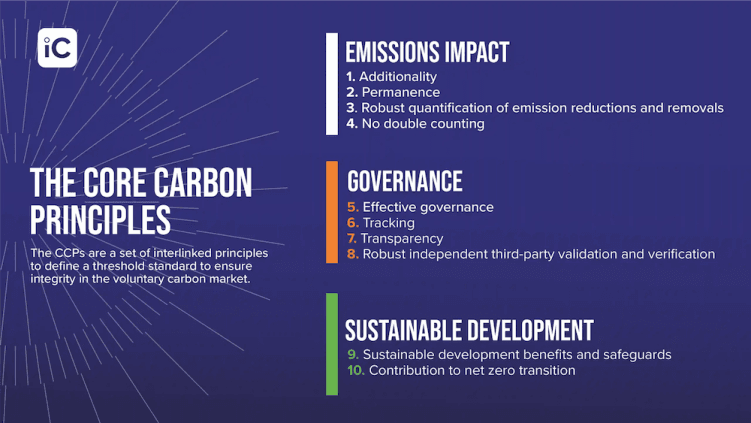
The Integrity Council for the Voluntary Carbon Market (ICVCM) recently finalised its Core Carbon Principles (CCPs). This new global benchmark for carbon offset projects aims to improve integrity and transparency in the voluntary carbon market (VCM). This unregulated market is currently valued at $ 2 bn annually and is predicted to grow to $250 bn USD by 2030. A recent report by Barclays predicts the VCM to reach a value of $1.5 tn by 2050. The new ICVCM standards define a global quality threshold for the trading of carbon credits, setting out how the VCM can reach its full potential.
According to the ICVCM, “The CCP label is designed to build trust and unlock investment by making it easy for buyers to identify a high‑integrity credit no matter which carbon‑crediting program issued it, what kind of credit it is, or where it is generated.”
The CCPs, first distributed in March 2022 and finalised at the end of July this year, provide definitional guidance for assessing the integrity of carbon credits.
Specifically, CCP labelled offsets must fund projects that reduce and remove emissions in line with a clearly defined transition to net zero. Credits must also be robustly quantified, must prove additionality (i.e. that carbon reductions would not have occurred without the carbon offset project’s existence), they must undergo regular monitoring and reporting on realised emissions reductions and commit to removals over at least a 40‑year timeframe. Credits will receive the CCP label only if both the development project from which the credits were issued and the type of offset – e.g. blue carbon – are assessed by the Integrity Council and meet its standard for high‑integrity.
The CCPs provide clear guidance for offset buyers to purchase with confidence and project developers to command a fair price by outlining precise and achievable definitions of high quality and integrity. This will build market confidence while at the same time demonstrating the positive socio‑economic and environmental benefits that carbon projects directly generate. An efficiently regulated and managed VCM has the potential to mobilise the investment required to reduce and remove carbon dioxide from the atmosphere at the levels needed to avert a climate catastrophe, in line with the Paris Agreement. When implemented alongside emission reduction strategies, high‑quality offset projects are an essential component of meeting this massive global challenge.
Carbonaires welcomes the issuance of the CCPs. They align with our philosophy, business model and core values in promoting high‑integrity carbon offsets in a VCM that is based on science, motivated by ethics, delivered through technology and enabled by finance.