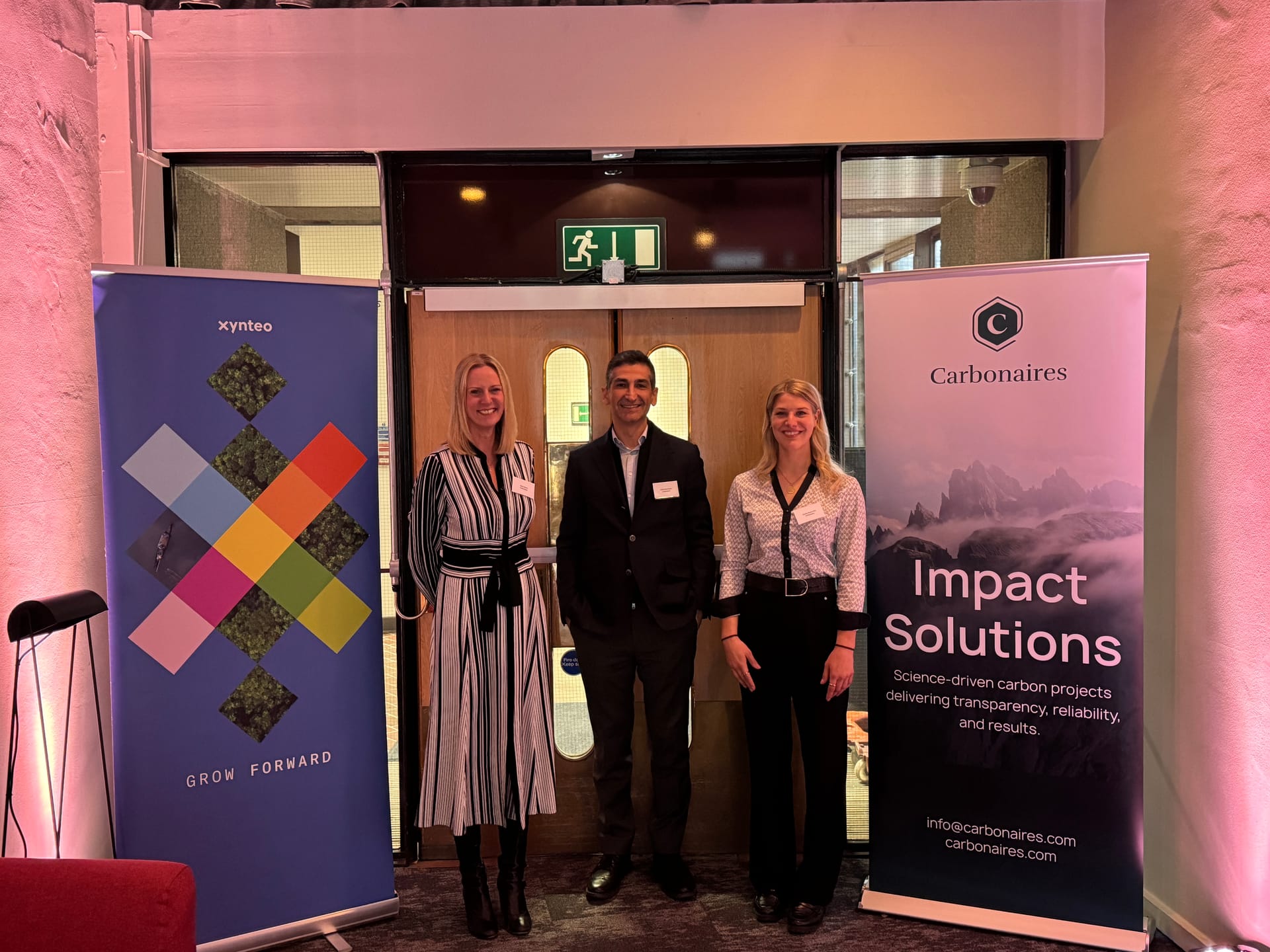
The Carbonaires and Xynteo partnership event at the Barbican in London brought together investors, project developers, sustainability leaders and corporate organisations navigating the voluntary carbon market. The conversation covered carbon removal, climate finance and what credible net zero strategy actually looks like in practice. Here are the key takeaways shaping how companies move from ambition to execution.
1. Inaction is not the safe option it appears to be
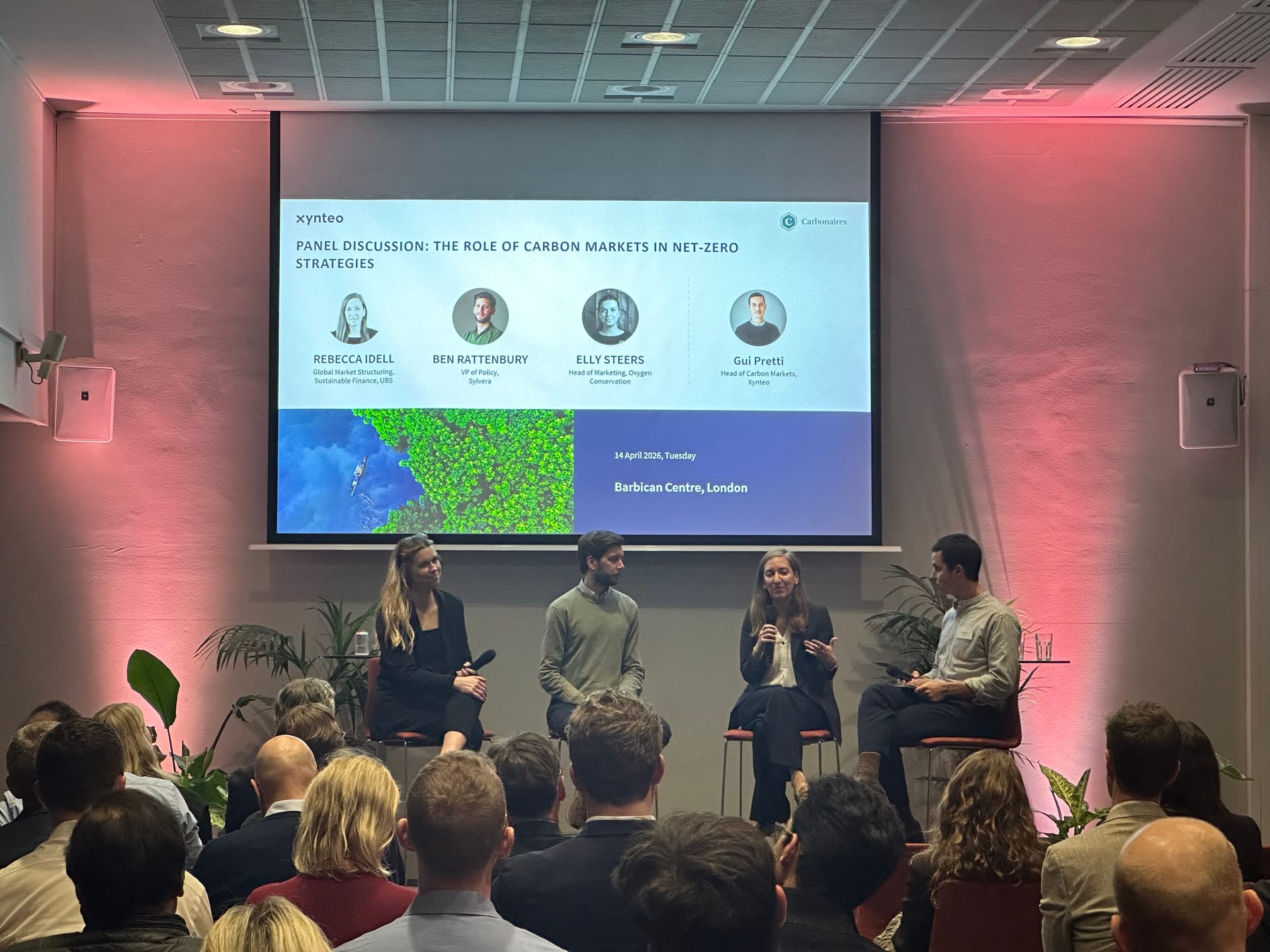
One of the sharpest points of the evening came from Ben Rattenbury, VP Policy at Sylvera.
It is currently safer for companies to do nothing than to buy carbon credits. This is absurd and must change.
— Ben Rattenbury, VP Policy, Sylvera
That asymmetry is one of the most damaging dynamics in carbon markets today. Demand for high-integrity carbon credits is rising, the strongest projects are already being secured through offtake agreements, and building the internal governance required to participate effectively takes time. Companies that wait for a perfectly de-risked market may find the most credible supply has already been contracted, and that the commercial advantage of early participation is gone.
2. Scrutiny is a feature, not a problem. Low quality is the problem.
The panel was aligned: increased oversight and tighter standards are not barriers to progress. They are what makes a market that institutions and corporates can actually trust.
Elly Steers from Oxygen Conservation made this concrete. After acquiring an estate, it takes 12 to 18 months of data review before delivery can even begin. Oxygen Conservation sells at approximately £125 per tonne.
If you want to plant a million trees, you need experts, and that costs money.
— Elly Steers, Head of Storytelling, Oxygen Conservation
High-quality supply is expensive for a reason. Credibility has real operating costs, and buyers need to evaluate high-integrity carbon credits accordingly.
3. Institutional finance is moving in, but structures are everything
Rebecca Idell from UBS put it plainly.
You need to meet the investor community where they are.
— Rebecca Idell, Global Market Structuring, Sustainable Finance, UBS
For banks, carbon markets are still perceived as novel and therefore higher risk. That is a risk framework problem, not an appetite problem. Offtake agreements, robust standards and structures like the World Bank outcome bond, which protects principal while offering carbon-linked upside, are what make participation viable for institutions that cannot absorb open-ended downside.
4. Community benefits are core to project quality, not peripheral to it
The evidence across the market is consistent: projects with stronger community engagement perform better on ratings and demonstrate more durable permanence outcomes. For host communities, livelihoods and land rights are the primary concern; climate impact is often the co-benefit, not the other way round. That framing matters for how developers design and resource their community programmes from the outset. Developers that treat engagement as a compliance exercise are building on unstable ground, and as buyer sophistication increases, that will show up in pricing and commercial terms, not just reputational exposure.
What this means for carbon markets
Demand for high-quality carbon credits is increasing, shifting toward integrity and removals, and becoming more sophisticated in how it evaluates projects. Buyers are prioritising verification, durable co-benefits and transparent delivery. The days of treating carbon credits as a commodity offset purchase are largely over for organisations that want to make credible net zero claims.
The gap between commitment and execution remains the biggest barrier. Many companies agree that carbon removal will form part of a credible net zero strategy, but fewer have built the internal capability or governance to act on it. Part of the reason is the “green hushing” phase that followed the ESG backlash, pushing many organisations into public caution despite private engagement. That dynamic is shifting. In private conversations, sustainability is being framed around whole-business integration and scalability, not reputational risk management. The commercial case for carbon markets is strong and should be front and centre.
The policy backdrop is moving, even if unevenly. The UK has been identified as a jurisdiction to watch for near-term developments, and Carbon Budgets 6 and 7 will be extremely challenging to meet. Carbon markets are increasingly seen as one of the tools available to close that gap. It is also worth noting that despite the current political headwinds in the US, the market has continued to advance. Diversified demand across geographies and sectors is part of what makes the market more resilient to any single government’s position.
Voices from the Global South also remain underrepresented in market narratives and standards development despite being central to project delivery. As the market scales, that imbalance will become harder to defend. Greater direct representation is a foundation issue, not just an equity one.
The UBS and Carbonaires relationship illustrates what early institutional participation looks like in practice. UBS made their first carbon removal investment with Carbonaires’ support, covering project origination and due diligence, enabling the investment to pass through internal approval and scale. It is a replicable model. The pathway for institutional participation exists; it requires the right partners and frameworks, not a wholesale change in how institutions assess risk.
This is where structured approaches and platforms like Carbonaires support faster, more credible decision-making in carbon markets, carbon removal and wider corporate decarbonisation strategy.
Carbonaires perspective
At Carbonaires, we see three clear shifts emerging from discussions like this.
First, the market is moving from intent to execution. Buyers want practical pathways into carbon markets, not abstract ambition. The questions being asked are operational: how do we build governance, assess projects and enter offtake agreements with confidence? Companies that cannot answer those questions internally are already behind.
Second, quality is being priced and differentiated. The voluntary carbon market is increasingly rewarding projects that can demonstrate integrity, transparent delivery and durable co-benefits. The gap between high-quality and low-quality supply, in both price and credibility, is widening. Buyers who cannot distinguish between the two are exposed to both reputational and commercial risk as standards tighten.
Third, timing is a strategic variable. Companies that act early are better positioned as regulation tightens, scrutiny increases and high-integrity supply becomes harder to access. Corporate buyers who move early and communicate that publicly create a ripple effect that does as much for market growth as the transaction itself. Carbon leadership also carries a non-financial dimension worth naming: it makes employees proud and is a genuine talent attraction and retention tool. Waiting may feel prudent in the short term. It is increasingly a strategic disadvantage.
Companies that act early will be better positioned as regulation tightens and scrutiny increases.
Event details
Final thought
Carbon markets are no longer a future consideration. The question is no longer whether to engage. It is whether your organisation has started building the understanding required to do so credibly.