AI Infrastructure, Energy and the Carbon Market Opportunity: Key Takeaways from the Barclays NextGen Energy Conference 2026

AI Infrastructure is Becoming an Energy Story: Carbon Markets Should Pay AttentionAI Infrastructure is Becoming an Energy Story: Carbon Markets Should Pay Attention — Barclays NextGen Energy Conference 2026 key takeaways from Carbonaires

The most commercially relevant theme from the Barclays 2026 Energy Conference was not simply the scale of AI investment. It was the growing realization that AI infrastructure is now an energy, grid, resilience, and carbon market story.

The next phase of digital infrastructure will require enormous amounts of reliable power. Data centers, AI training, inference workloads, battery storage, grid upgrades, nuclear, critical minerals, and behind-the-meter generation are increasingly part of the same strategic conversation.

For carbon markets, this matters.
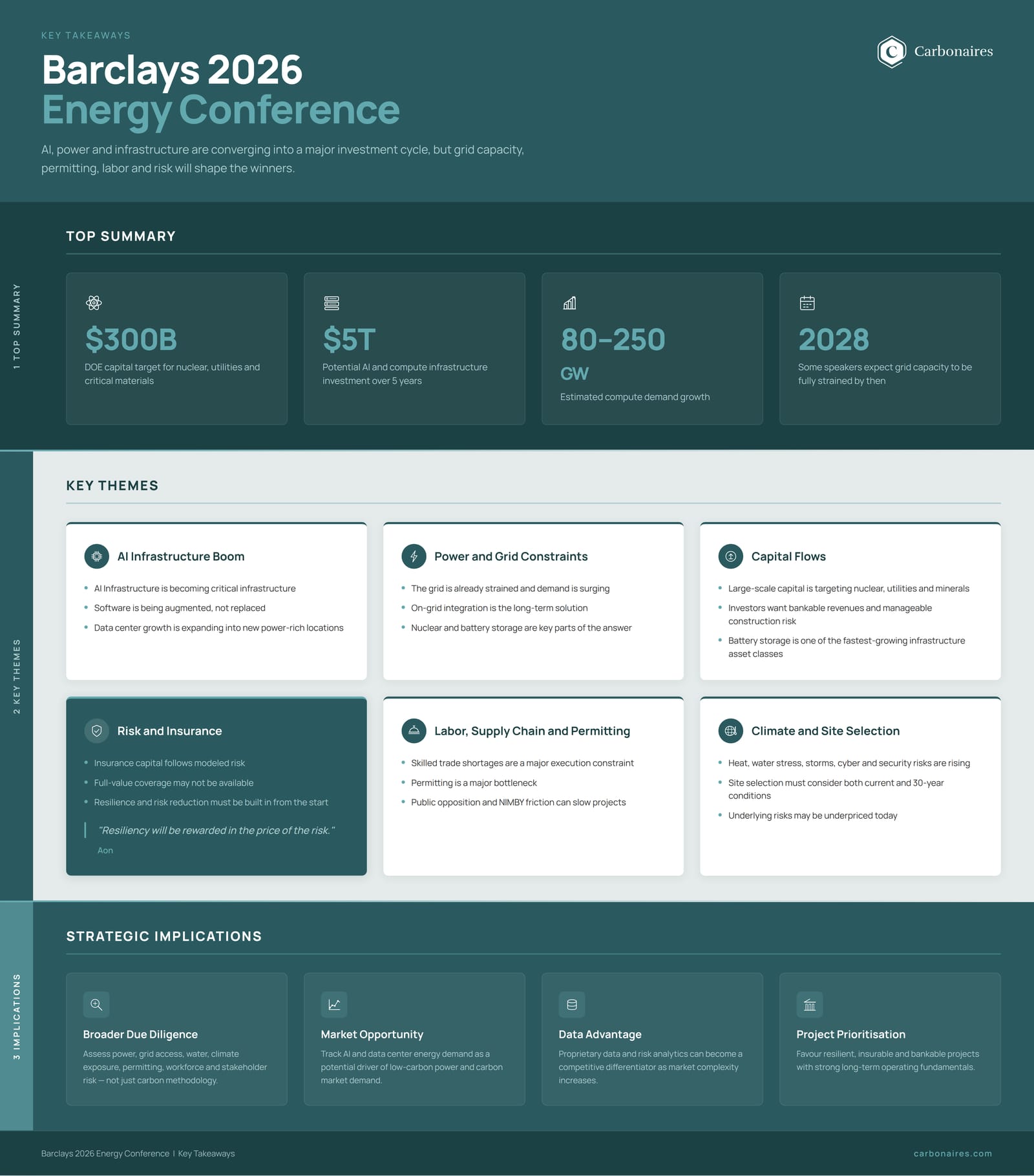
Infographic summarising the Barclays 2026 Energy Conference: $300B capital target for nuclear and utilities, $5T potential AI and compute infrastructure investment, 80–250 GW estimated compute demand growth, and grid capacity expected to be fully strained by 2028 — with key themes covering AI infrastructure, power and grid constraints, capital flows, risk and insurance, labor and permitting, and climate and site selection.
Top takeaways from the Barclays 2026 Energy Conference: AI, power and infrastructure are converging into a major investment cycle.

1. AI growth is creating a new infrastructure demand cycle

AI is often discussed as a software revolution, but its physical footprint is becoming impossible to ignore. Compute demand requires land, power, cooling, grid interconnection, financing, skilled labor, and long-term risk management.

At the conference, speakers pointed to the potential for trillions of dollars of AI and compute infrastructure investment over the next five years. They also highlighted the pressure this growth is placing on the grid, with some expecting grid capacity to become a defining constraint by 2028.

Audience seated under chandeliers at the Barclays NextGen Energy Conference 2026 in New York, with Barclays branding on stage and side screens during a panel session
The Barclays NextGen Energy Conference 2026 — A Digital Infrastructure Era, New York, 14 April 2026.

2. Data center growth may reshape demand for high-quality carbon solutions

Hyperscalers and large digital infrastructure companies are already among the most sophisticated buyers of clean power, carbon removal, and climate-related solutions. As AI infrastructure expands, those companies will need to address several overlapping priorities:

They need reliable power;
They need resilient infrastructure;
They need credible climate strategies; and,
They need solutions that can withstand scrutiny from investors, customers, regulators, and the public.

This is where high-quality carbon markets become strategically relevant.

If AI-driven energy demand grows faster than clean power supply, companies will face a difficult balancing act. They will need to procure low-carbon power where possible, invest in grid and storage solutions, and address residual emissions through credible carbon removal and high-integrity carbon credits.

That does not mean carbon credits should become a substitute for decarbonization. They should not. But it does mean that credible carbon markets may become an important part of how large energy users manage unavoidable emissions, support climate-aligned infrastructure, and accelerate investment into projects that remove or reduce carbon.

The opportunity is not generic carbon. It is quality, durability, and trust.

One clear implication is that demand will likely concentrate around projects that can demonstrate strong fundamentals.

This means the commercial opportunity is not simply to source carbon credits. It is to underwrite quality.

The strongest projects will need to show:

Clear additionality;
Strong measurement, reporting, and verification;
Durability of carbon benefit;
Operational resilience;
Credible counterparties;
Sound economics;
Appropriate insurance and risk controls; and,
Manageable exposure to climate, water, permitting, labor, and stakeholder risks.

This is especially important because the same risks affecting energy infrastructure also affect carbon projects. Water stress, heat, severe weather, local opposition, permitting delays, supply chain constraints, and long-term site viability all matter.

A carbon project is not just an environmental asset. It is also an infrastructure, finance, operational, and risk management asset.

Three panellists seated on stage in front of Barclays-branded backdrop at the Barclays NextGen Energy Conference 2026, mid-discussion
Panel discussion at the Barclays NextGen Energy Conference 2026, exploring the strategic priorities of hyperscalers and digital infrastructure operators.

3. Resilience may become a commercial differentiator

One of the strongest messages from the conference was that resilience will increasingly be reflected in the price of risk.

That is highly relevant to carbon markets.

A project that is theoretically attractive from a carbon methodology perspective may still be commercially weak if it cannot operate reliably, insure effectively, withstand climate stress, or maintain stakeholder support over time.

Likewise, a project with strong resilience characteristics may become more attractive to buyers, investors, and financing partners.

This suggests that due diligence should continue to go beyond carbon accounting. The market will increasingly reward projects that can demonstrate long-term operating strength, not just near-term credit generation.
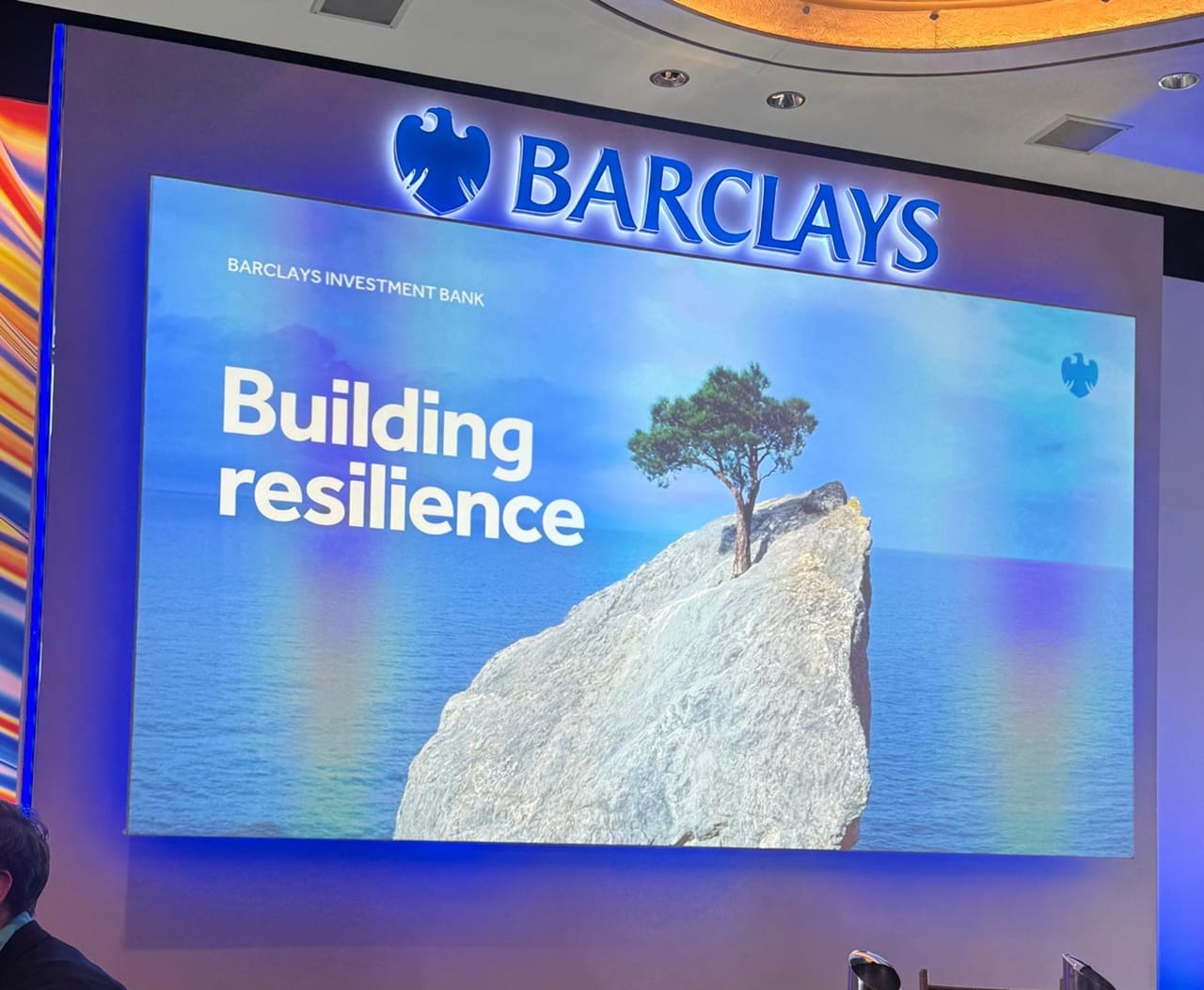
“Building resilience” keynote slide on stage at the Barclays NextGen Energy Conference 2026, with a Barclays Investment Bank backdrop and an image of a tree growing from a rock surrounded by sea
“Building resilience” — a central theme of the Barclays NextGen Energy Conference 2026.

4. Proprietary data and analytics could become a competitive advantage

Another important theme from the conference was the value of proprietary data. In infrastructure, data is becoming a competitive advantage. The same should be true in carbon markets.

For carbon removal projects, this could mean building deeper intelligence around:

Project performance;
Delivery risk;
Climate exposure;
Counterparty strength;
Insurance availability;
Buyer preferences;
Pricing trends;
Methodology risk;
Long-term durability; and,
Portfolio concentration.

Companies that can combine carbon expertise with infrastructure risk analytics may be better positioned to help buyers and investors navigate a more complex market.

5. The bigger picture

AI infrastructure is accelerating a global conversation about power, resilience, and capital allocation. That conversation is increasingly connected to the future of carbon markets.

The opportunity is to help ensure that capital flows toward credible, resilient, high-integrity carbon projects that can stand up to commercial, environmental, and reputational scrutiny.

The next phase of the carbon market will not be built on volume alone.

It will be built on trust, data, project quality, and the ability to connect climate impact with real-world infrastructure needs.

Event details

Event: Barclays NextGen Energy Conference 2026: A Digital Infrastructure Era
Host: Barclays
Location: New York
Date: 14 April 2026
Carbonaires attendee: Jerome Ryan
byJerome Ryan
11 May 2026

Recommended

See more related news

Energy Tech Summit Bilbao 2026
11 May 2026

Energy and Carbon Are Now One Conversation: Reflections from Energy Tech Summit 2026

Reflections from Energy Tech Summit 2026 at the Euskalduna Conference Centre in Bilbao (15–16 April 2026). 1,400+ senior attendees from KKR, BlackRock, Shell, Microsoft, NVIDIA, Iberdrola and more set out how the energy infrastructure build-out has fully absorbed the carbon question — and what that means for high-integrity carbon removal demand, the “last 20%” problem and compute-linked credit models.

Carbonaires RFP for Financing Offtake-Backed Carbon Removal Projects
27 April 2026

Carbonaires Launches RFP for Offtake-Backed Financing of High-Integrity Carbon Removal Projects

Carbonaires today opens its Request for Proposals (RFP) for offtake-backed financing of high-integrity carbon removal projects globally. Open to all engineered and nature-based pathways with a minimum $3 million offtake contract, the RFP brings Carbonaires’ network of institutional investors to qualified developers through a structured, two-stage process. Submissions close 22 May 2026.

European Climate Summit 2026, Barcelona
18 April 2026

A Decisive Phase for Carbon Markets: Key Takeaways from IETA's European Climate Summit 2026

IETA's European Climate Summit 2026 in Barcelona brought together policymakers, investors and corporate sustainability leaders to address the most pressing questions in carbon markets today. Here are the key takeaways on EU ETS reform, Article 6, carbon pricing redesign and why demand-side policy needs to move faster than supply.

Newsletter

Stay up to date with our newsletter

We will keep you updated on the latest news in green finance, if you subscribe to our newsletter. You can consent to receive our newsletter here.

By clicking "Subscribe" you agree to receive newsletters about any updates, events, news, special offers, surveys, and promotions via email in accordance with the Privacy Policy.

You may always withdraw your consent by clicking on the unsubscribe link in any newsletter you have received from us.

Press Release · 27 April 2026

Open Now: RFP for Financing Offtake-Backed Carbon Removal Projects

Carbonaires is financing high-integrity removal projects with $3M+ offtake contracts. Submissions close 22 May 2026.

Read the announcement