COP31 preview briefing paper
This briefing paper previews COP31, held in Antalya from 9 to 20 November 2026, and what it means for carbon removal. It covers the backdrop to the talks, Article 6 and carbon markets, and the policy and corporate signals shaping demand for removals.
Written by Marika Niekowal for corporate buyers, investors and project developers, it sets out practical next steps for each.
Get your free copy
Executive summary
The Article 6 rulebook is complete, so COP31 is about implementation and funding rather than new carbon market rules. At the same time, demand for high-integrity credits and removals is starting to show up in sovereign tenders, emissions trading systems and corporate standards.
The paper places the talks against sobering warming projections, the United States' exit from the Paris Agreement and an energy shock that has raised the priority of energy security. It examines a funding shortfall in the UN's Article 6.2 systems, government tenders for Article 6 credits, how a UK-EU emissions trading link could treat removals, a new removals requirement from the Science Based Targets initiative and the growth of AI data centres. It closes with next steps for each audience and a common thread: 'integrity is the price of entry'.
Key points
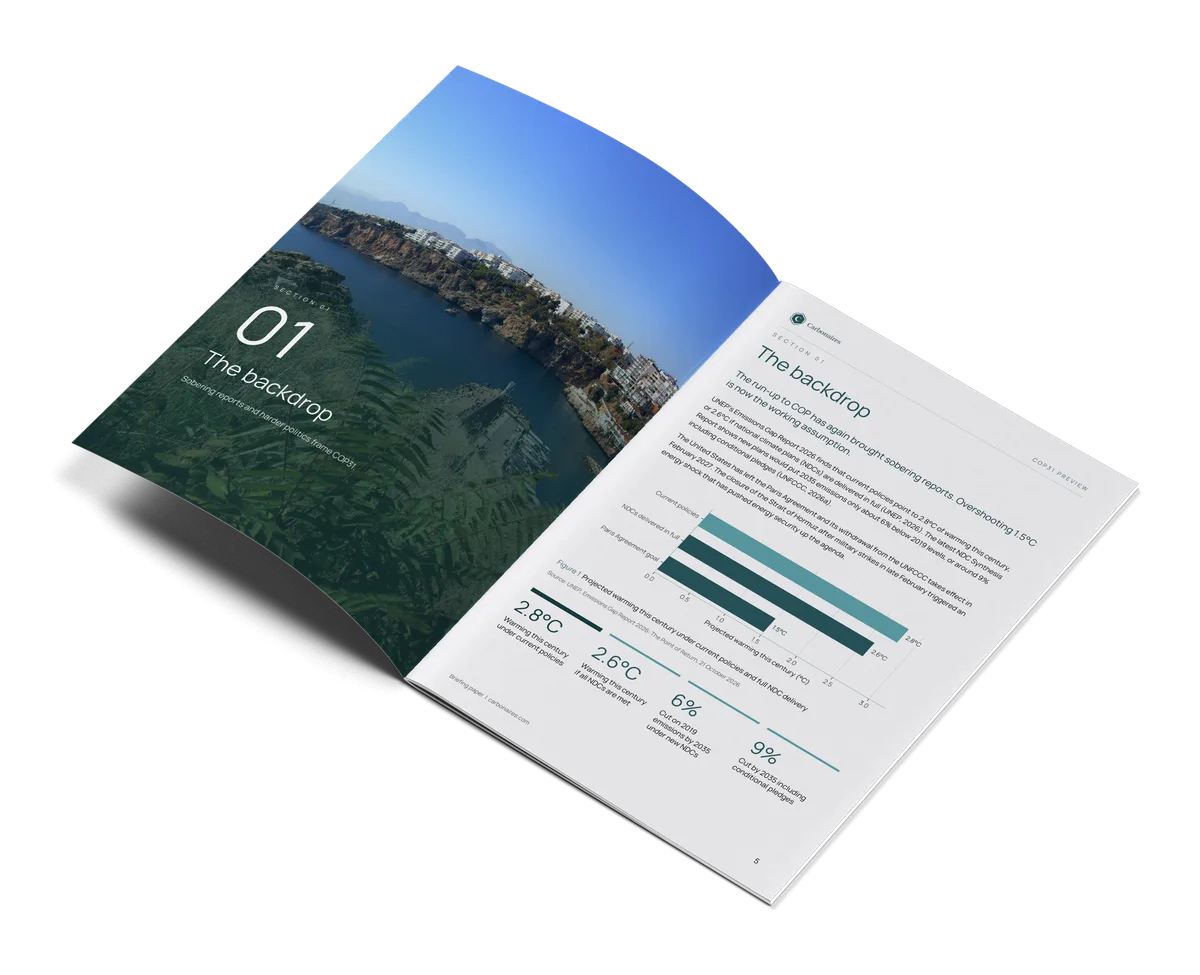
- UNEP's Emissions Gap Report 2026 projects 2.8°C of warming this century under current policies, or 2.6°C if all national climate plans (NDCs) are met. The latest NDC Synthesis Report puts the cut in emissions by 2035 under the new plans at about 6% on 2019 levels, or around 9% with conditional pledges.
- The Article 6 talks centre on funding: the UN systems behind Article 6.2, including the international registry and technical expert reviews, face a shortfall of about US$8 to 9 million. The Paris Agreement Crediting Mechanism (PACM) has five approved methodologies and its first issuance, but its registry is not expected before early 2027 and several removal-related rules roll over into 2027.
- Sovereign buyers have started tendering for Article 6 credits. Germany is seeking up to 1.1 million PACM credits to cover federal government travel and events, and Singapore at least 12 million internationally transferred mitigation outcomes (ITMOs), which could include removals.
- The UK and EU emissions trading systems take different routes to durable removals: the UK's approach is to integrate engineered removals, while the EU's is to auction 250 million extra allowances between 2031 and 2040 and use the funds to buy permanent removals. A link between the two, up for discussion at the UK-EU summit in Brussels on 20 November, would have to reconcile these approaches.
- Under the Science Based Targets initiative's new Corporate Net-Zero Standard, large and medium-sized companies in high-income countries must support removals equivalent to at least 1% of their ongoing emissions from 2035. The paper finds that this, with the Coalition to Grow Carbon Markets' principles, raises the bar for credit quality and claims.
- The Antalya Artificial Intelligence Pledge notes, citing the IEA, that electricity use by AI-focused data centres rose by 50% in 2025, but it does not mention carbon removals. Microsoft alone accounted for 78.5% of durable carbon dioxide removal (CDR) tonnes contracted in CDR.fyi's April 2026 snapshot.