Carbon removal projects are securing buyers and attracting investment. Bringing more debt into the market depends on whether contracts provide enough certainty over revenue and allocate risks in a way that projects can sustain.
These questions shaped our closed-door Climate Week NYC roundtable, where investors, lenders, insurers, traders and market builders discussed the next phase of carbon dioxide removal finance.
Three opening briefings were followed by facilitated discussions on three topics, with conversations continuing over drinks on the rooftop.
Opening briefings
Our Policy Manager, Marika Niekowal, opened the briefings with a review of demand for removals. She considered how policy could build on buyer commitments, with projects so far attracting capital mainly through equity and grants.
SBTi’s Corporate Net-Zero Standard V2 sets out future removals requirements for Category A companies from 2035, while ISO’s draft net-zero standard proposes removal milestones starting within five years of target setting. Public procurement could add to this demand through the European Commission’s proposed EU ETS revision, which would create a purchasing programme for eligible permanent removals from 2031 (SBTi, 2026; ISO, 2026; European Commission, 2026).
Marika also drew on early findings from our RFP for offtake-backed financing to examine how demand translates into project finance. Many offtakes are too small relative to the capital required, and a meaningful share of demand comes through intermediaries rather than rated corporate buyers. Even with an offtake in place, projects often lack the equity or first-loss capital needed to support lending.
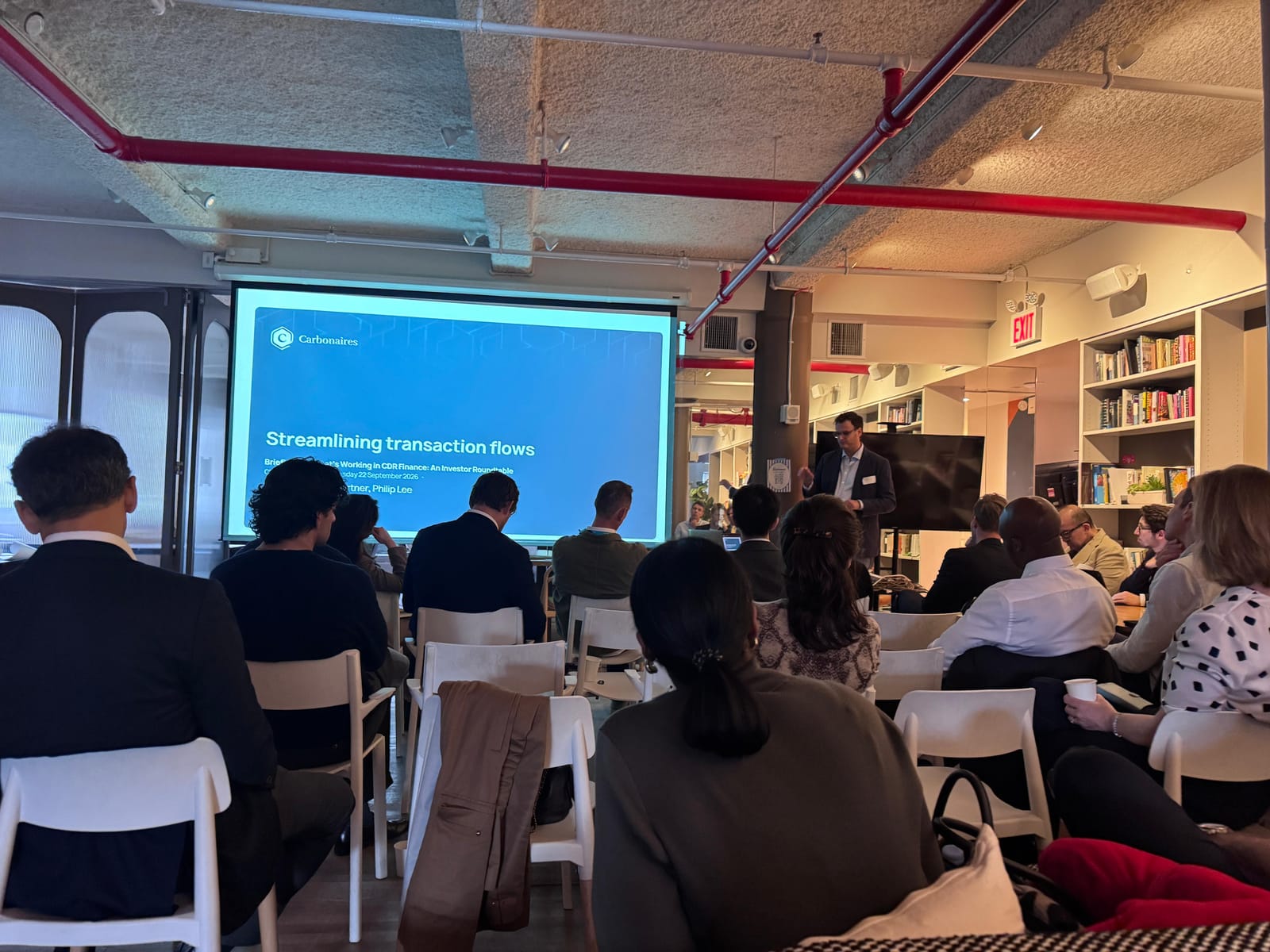
In the second briefing, Ryan Covington of Philip Lee discussed how involving funders early in offtake negotiations could help improve transaction flow efficiency from term sheet to close.
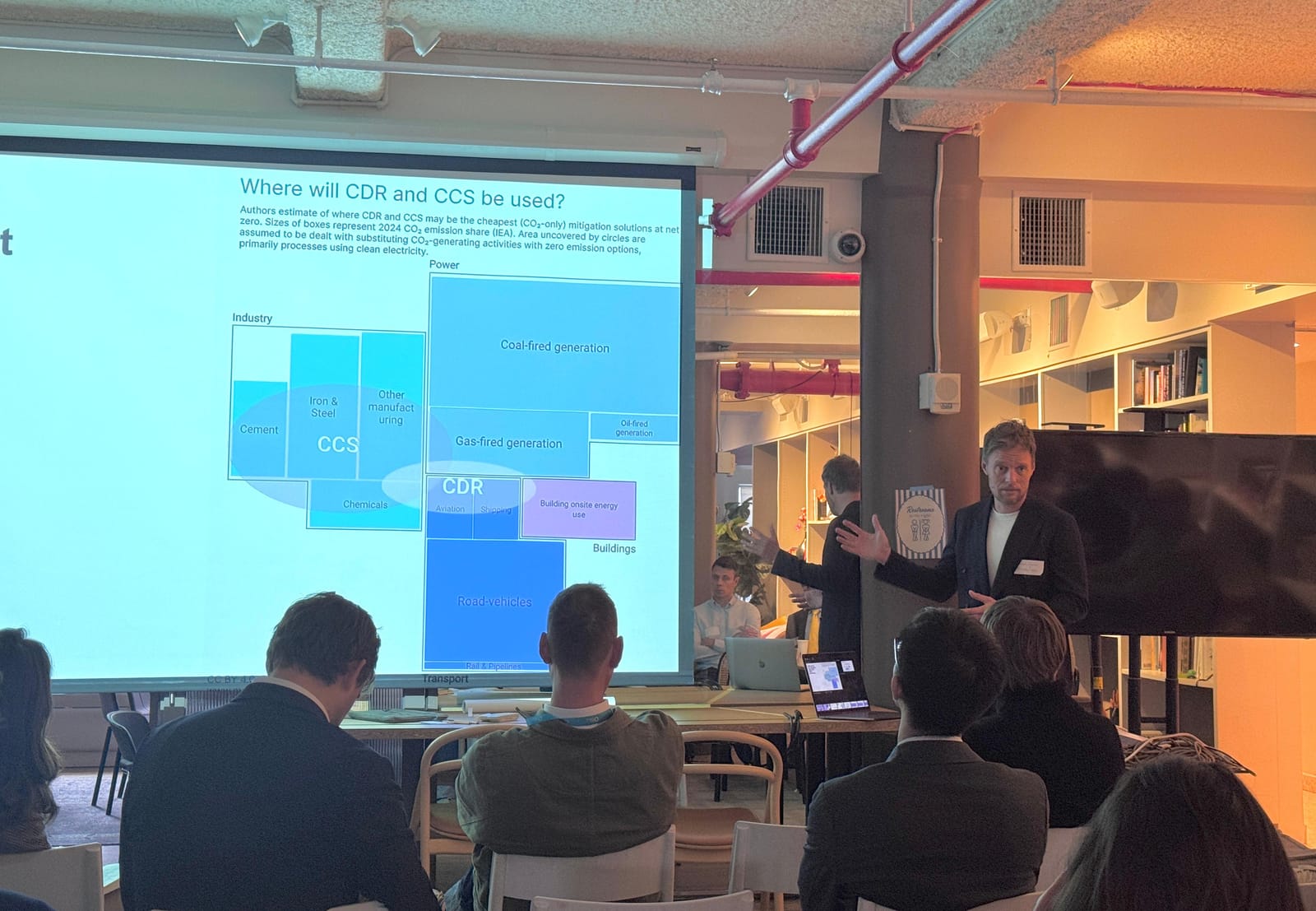
Robert Höglund of Milkywire gave the third briefing, returning to the role of removals in corporate targets. He challenged the definition of residual emissions and made the case for operational net zero.
Three discussion topics
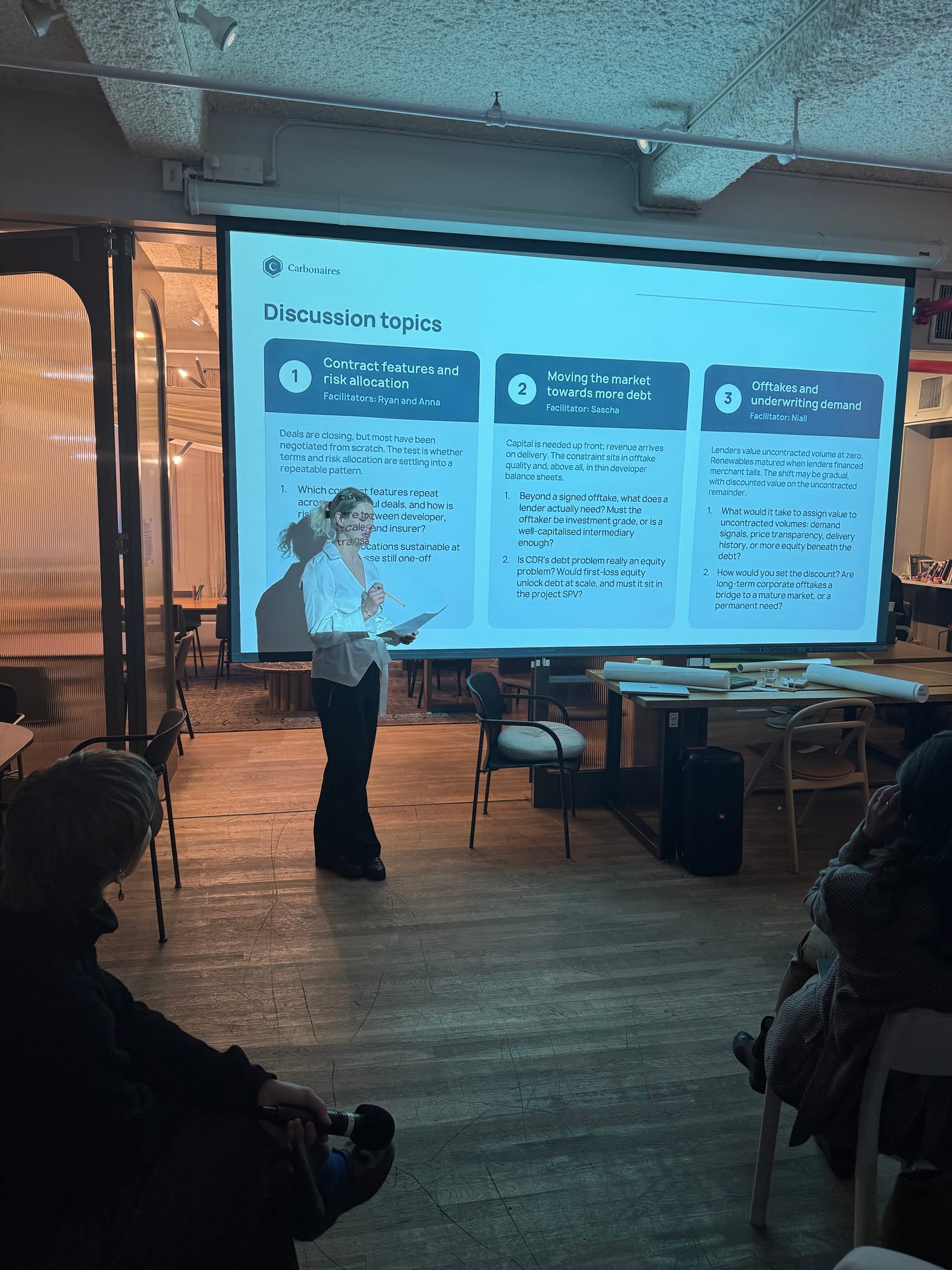
1. Contracts and risk allocation
The first discussion, facilitated by Anna Hickey and Ryan Covington of Philip Lee, focused on how firm offtake commitments and remedies for under-delivery can give buyers and lenders confidence in delivery. Some participants favoured firm liquidated damages, while others preferred more flexible delivery terms, with minimum volumes and provisions for delays.
For lenders, those remedies need to sit alongside clear operational delivery requirements, aligned with milestones in the debt agreements. Contracts also need to allocate political, regulatory and claims risks explicitly, particularly where eligibility for compliance markets may change.
These protections have to be workable for developers too. Participants raised concerns about bargaining power and terms that developers cannot realistically meet. If those terms put a project at risk, they can weaken the delivery certainty buyers and lenders need.
2. Bringing more debt into CDR
The second discussion, facilitated by our Chief Commercial Officer Sascha Roest-Ellis, considered what projects need to demonstrate before lenders can commit. Lenders assess how much output is contracted and whether expected cash flows can cover debt service. Buyer creditworthiness and the developer’s track record inform that assessment, alongside the lender’s priority in the project’s cash waterfall.
Participants described projects still at pilot stage, assembling several small offtakes when an investor would prefer one larger, dependable agreement. They discussed whether portfolios, consolidation among developers and intermediaries warehousing credits could help finance supply at a larger scale.

Alongside the size of offtakes, participants considered whether projects can draw on other revenues. Lenders value income beyond carbon, and participants questioned whether financial additionality tests can discourage revenue streams that would otherwise help projects attract debt.
Public support was discussed as another part of the financing mix. Participants pointed to renewables, where the progression from sovereign to corporate power purchase agreements came before lenders became more comfortable with merchant exposure. Building comparable confidence in CDR will take time.
The discussion of biochar highlighted a shortage of capital to support lending. Debt was described as scarce and equity as arriving piecemeal, with first-loss capital largely absent. The view was that first-loss support would be most useful within a project’s financing structure, where it could absorb risks lenders are not yet willing to take.
3. Offtakes and uncontracted supply
The third discussion, facilitated by Niall MacDowell of Imperial College London and Carbonaires’ Science Advisor, looked at how investors should value supply that has not yet been contracted. Lenders are reluctant to take merchant risk, while equity investors may see uncontracted output as an opportunity for additional returns. For developers, retaining some tonnes can also provide a buffer against non-delivery penalties or a source of revenue where contracted volumes alone do not support the investment needed.
Delivery experience helps investors assess these risks. Lenders need evidence that credits can be delivered, and that record matters to equity investors too as they carry risk through construction.
Confidence in future demand also matters when valuing uncontracted supply. Participants saw policy as important for sustaining that demand, with long-term offtakes likely to remain central to financing.
The next stage of work
The three discussions pointed to practical work still needed to bring more lenders into CDR. Sufficient committed revenue gives lenders a basis for investment, while contracts need to protect funders on terms developers can meet. Alongside those contracts, projects need enough equity or other capital to absorb risks that lenders are not yet willing to take.
We are drawing these findings together in a Carbonaires briefing paper on carbon removal finance, which we will publish ahead of COP31.
Thank you to everyone who joined and shared their experience, and to Philip Lee for supporting the roundtable as our knowledge partner.